This topic is something I never learned in linear algebra class. Here I reproduce the exposition by Tosio Kato in Short Introduction to Perturbation Theory for Linear Operators. Go read that book, these notes are just a worse version where I ignore most of the discussions about convergence. But I do fill in some details of the complex integrals and sketch the solutions to some problems, and also include material taken as a given. This is the start of a series of notes.
Definition of the Resolvent
Let be an linear operator . Let the set of eigenvalues of T be . The operator is nonsingular whenever , since then has no zero eigenvalues. In this case we can define , called the resolvent. The resolvent can refer to both the function and the operator for any particular value of .
Properties of
The first resolvent equation is . This can be seen by the following construction:
The resolvent therefore satisfies the commutation relation , since
The Resolvent as a Complex Function
Rearranging the resolvent equation we have
where we have used the Neumann expansion . So we can expand the resolvent at a given in terms of the resolvent somewhere else. The series converges if , and the condition may be weakened. is then a holomorphic function.
The other expansion we can use is the Laurent expansion about one of its poles, which are the eigenvalues of . Let be such an eigenvalue, and for now let it be . The Laurent series is where is an operator defined as
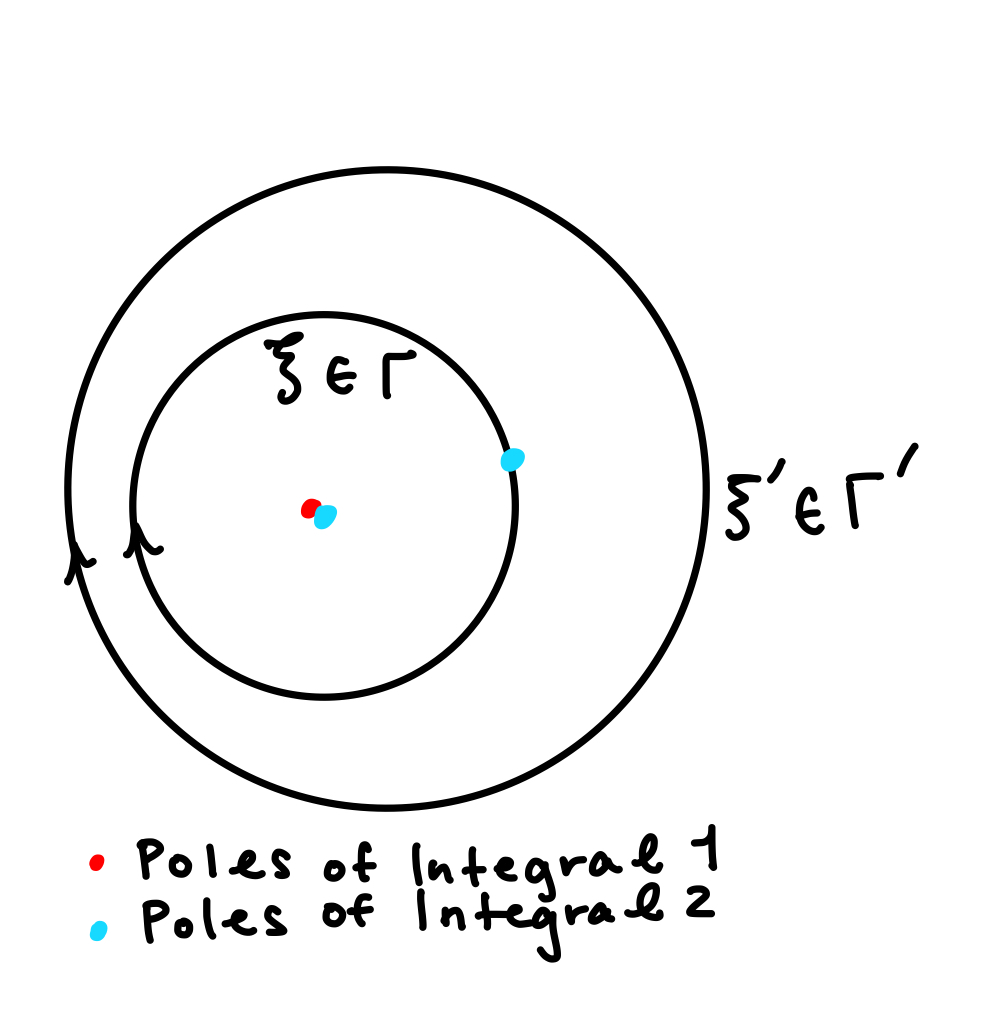
where is a small clockwise contour enclosing the pole but excluding the other eigenvalues. Let and be two contours with enclosing . Then
The first interior integral must be evaluated keeping in mind that will never be equal to on the interior of . In this case the singularity comes from and we get
The second interior integral has both poles, so we have
After inserting the integrals we deform the contours back to being the same and rename the variables so they are the same:
So we have recurrence relations for the coefficients of the Laurent expansion. Because we will continue using these operators, we give them special names. Let , , and . Important cases are:
: So is a projection operator.
has , , , etc. Therefore for .
We also have for .
We can break up the Laurent expansion in terms of these special operators:
and shift the pole to wherever the actual eigenvalue (in the sense that we redo all the work above around the actual eigenvalue) is, and rename our operators (, etc.) so that we keep track of which eigenvalue we are working with:
In light of 4. and 5. above, we see that
and
So we have decomposed into two parts, and accordingly the vector space . Let where and , so that .
We now show that is a meromorphic function, i.e. none of its singularities are essential. To do this, we examine the convergence of the principal part of the Laurent expansion, i.e. all the negative power terms. We can reproduce them here:
Since we expanded around an isolated singularity, we have no other singularities except at . Therefore has no other singularities except at . Since the singularity is right at , has a spectral radius of zero, i.e. it has no eigenvalues different from . This implies is nilpotent. Therefore the principal part only has finitely many terms, and hence converges. So is meromorphic.
We can see from the definition of that
where is a clockwise contour encircling but passing through no other eigenvalues. Now we can add together the projection operators for different so that
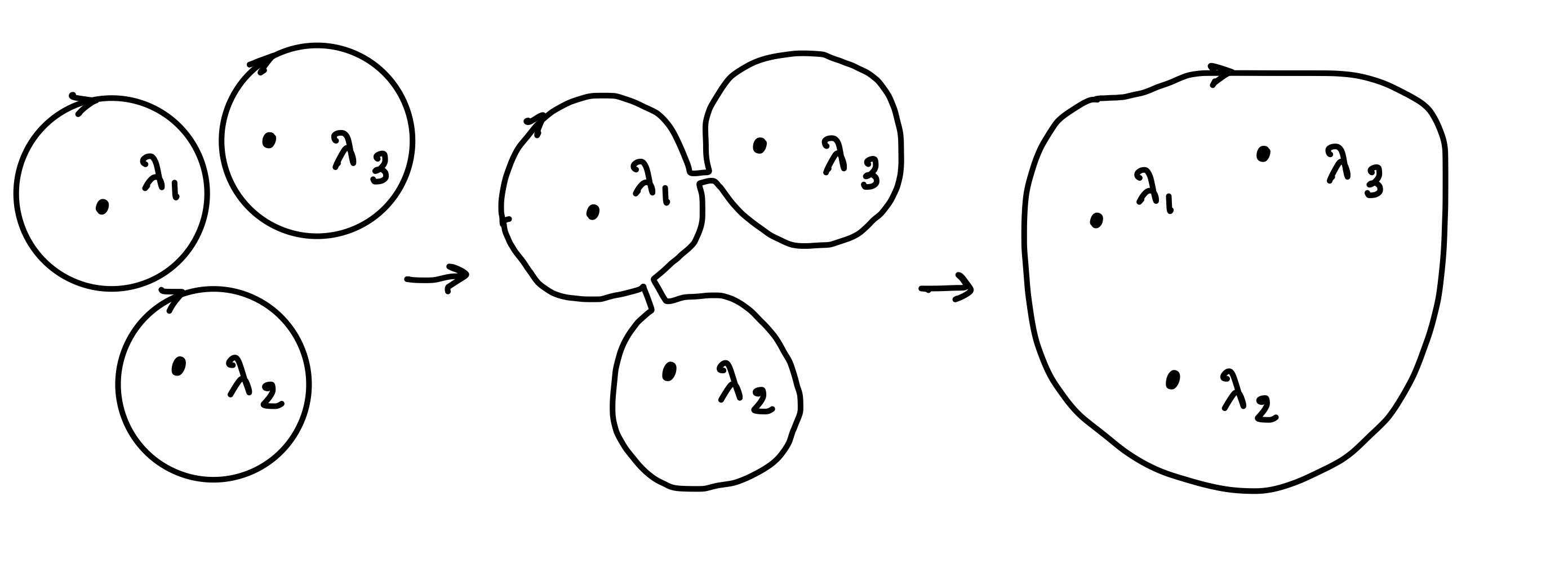
where we have deformed the contour in each such that the intersection of different countours cancel and we get one contour going around all the poles .
The meaning of the projection operators becomes clear when we derive the following identities:
1 ) Orthogonality:
Let and encircle distinct poles at and respectively. Then we the product is zero since the contours encircle no poles:
On the other hand if the poles are the same then by the above relation for the we have . So we get the above expression.
2 ) Completeness:
Let be a contour encircling all the eigenvalues. Then we can deform it out to infinity without encountering any further singularities. The behavior of at infinity is given by the Neumann expansion
In particular,
So we really can interpret the as the projection operators onto some space corresponding to . And now noting that commutes with because commutes with , we can identify it with the eigenspace of corresponding to .